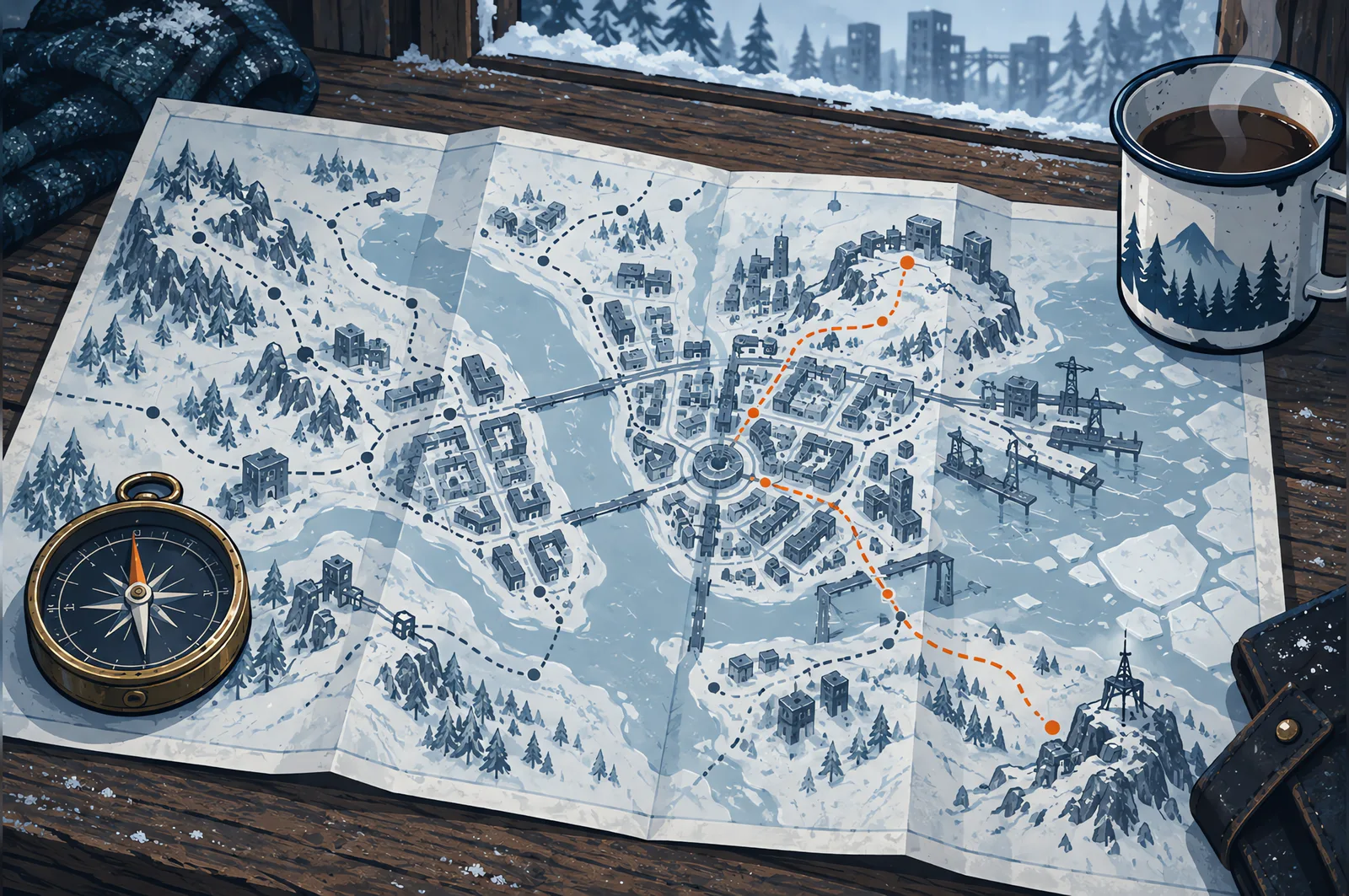
Permafrost is not one open field. The developers describe frozen city ruins that fade into wilderness, faction-controlled territories in between, brutal weather over the whole thing, and several biomes inside it. Progression is exploration-gated, so the map opens by restoring shelters and reclaiming technology rather than by ticking off region names.
The shape of the world
The setting is a near-future Earth locked in endless winter after catastrophes that culminated in the shattering of the moon. What is left reads as a layered surface: frozen city ruins, then wilderness, with faction-controlled territories cutting across both.
The developers call it a grounded, tense survival experience shaped by silence and scarcity, not by constant gunfire or fantasy tropes. Frostbite, storms and creeping chill are the named pressure, and the cold is described as your true enemy.
Early Access already ships several biomes, and the developer FAQ says more will arrive during the Early Access window and again in the full version, which is planned to add NPCs, enemies, equipment and vehicles.
What each world feature means for your route
| World feature | What it means for your route |
|---|---|
| Frozen city ruins | Dense scavenging ground, and the hardest place to find free warmth |
| Wilderness beyond the cities | Material thins out, so clothing quality becomes your only warmth |
| Faction-controlled territories | Crossing them is a route decision, not a combat one: know why before you commit |
| Brutal weather | Storms and creeping chill put a clock on every trip, so plan the leg around them |
| Several biomes | One route does not teach you the next one, so re-scout when the ground changes |
| Exploration-gated progression | Restoring shelters, repairing machines and reclaiming technology is how the map opens |
| Network of shelters | Each trip should end at the next link in the chain and extend it |
How to plan a route
The map opens by what you restore, not by what you survive. Plan each trip around one unlock: a shelter worth repairing, a machine worth fixing, or technology worth reclaiming. Everything else is logistics.
- Pick a target that changes something, not a distance. Progression runs through restored shelters, repaired machines and reclaimed technology.
- Chain shelters rather than returning home. Treat each existing shelter as a stage on the route, not a detour.
- Check warmth before the objective. Body Warmth drains when temperature is below what your clothing resists, and clothing quality decides how far you can go.
- Take the dog. It scouts ahead, warns of danger and carries supplies, which is worth most on ground you have not crossed.
- Leave the starting area early. Guide-level advice is clear that it is relatively safe, but that you run out of food quickly if you stay.
- Bank material at a shelter. Crafting and building draw on the same scavenged stock.
When to turn back
Turn back on warmth, not on courage. The clearest signal is a Body Warmth meter draining with no fire material and no warm settlement within reach. You cannot sleep unless you are adequately warm, so arriving at night without heat costs Energy instead of restoring it.
Two smaller signals matter. Stamina is short-term energy spent by sprinting, and at zero those actions are unavailable until it recharges. Energy is the need for sleep, and a night without warmth borrows from the next day.
Co-op does not simplify the world, so agree on the turn-back signal out loud: a group is harder to stop than one person.
What this site does not publish
This site publishes no named region list, no interactive map and no coordinate table. The developers have not published a region breakdown this site could source, so any such list would be invented. Specific region names are Unconfirmed (verify in-game). Where another guide shows a labelled map with exact coordinates, read it as that site's reading, not as published information.
What to read next
- Crafting Guide for what to do with the material a route brings home.
- Survival Basics for the warmth, Energy and Stamina rules that set the turn-back point.
- Multiplayer and Co-op for splitting a route across up to four players.
- Tips for short habits that shorten the walk home.
Sources
- Permafrost on Steam: setting, biomes, Early Access scope and the developer FAQ.
- Toplitz Productions deep dive news: the publishers on the frozen world and the October 9, 2026 release.
- Permafrost beginner guide (TechRaptor): guide-level advice on warmth, sleep and the starting area.
- Toplitz Productions game page: publisher page for Permafrost.